What prevents strategic intent from becoming operational reality?
From strategy to consistent results
Most organizations have a strategy. Fewer have a clear answer to how it should shape what happens in daily planning and execution.
The gap between the two rarely announces itself. It shows up gradually as missed targets, inconsistent decisions and a planning operation that depends on individuals rather than principles. Closing that gap is not primarily a technology problem. Technology can automate and scale good decisions, but only if those decisions are defined, owned and consistently applied in the first place. Our Decision and performance advisory work supports organizations at each stage of that journey.
Where strategy fails to translate into execution
Translating strategy into daily execution rarely fails in one place.
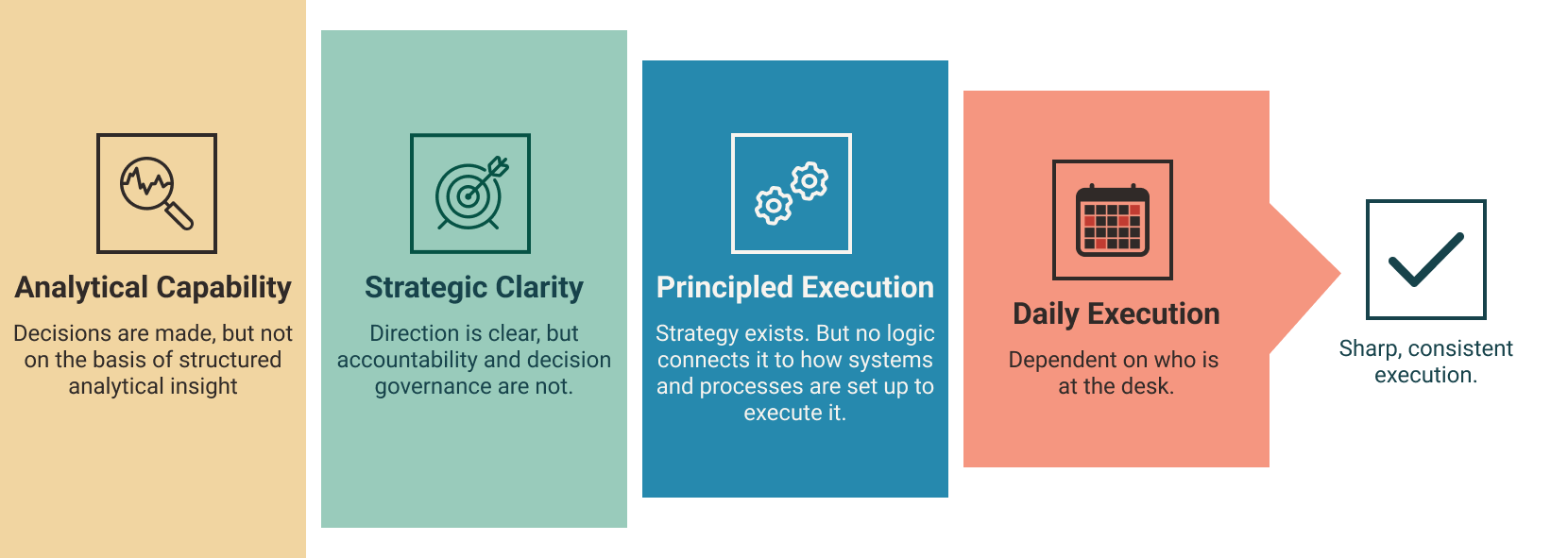
Most organisations will recognise at least one of these four dimensions in their own operations:
- Decisions are made without a clear analytical foundation
- Accountability is not clearly defined
- Systems do not reflect how decisions should be made
- Execution varies depending on who is involved
These are not isolated gaps. They are connected and reinforce each other. If one dimension is unclear or not functioning as intended, the overall flow breaks down. Consistent execution becomes difficult to achieve.
The structure below shows the four dimensions and where organisations typically experience the most friction.

Explore how each dimension can be addressed
Four dimensions. Six services. Some gaps need more than one entry point. Start where the friction is greatest.
Talk to a supply chain expert!
Ready to take your supply chain to the next level? Let’s talk. Our experts are here to help you find the right solutions for smoother, smarter operations.